Mexican Day of the Dead Charahcters Jarritos Clip Art
| Twenty-four hours of the Dead | |
|---|---|
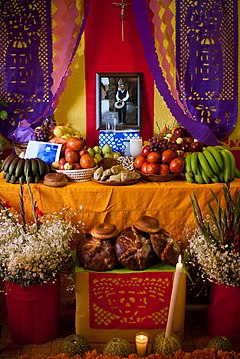 Día de Muertos altar commemorating a deceased man in Milpa Alta, Mexico City | |
| Observed by | Mexico, and regions with large Mexican populations |
| Blazon |
|
| Significance | Prayer and remembrance of friends and family members who have died |
| Celebrations | Creation of home altars to remember the dead, traditional dishes for the Day of the Dead |
| Begins | November one |
| Ends | November two |
| Date | November ii |
| Adjacent time | 2 November 2022 (2022-11-02) |
| Frequency | Almanac |
| Related to | All Saints' 24-hour interval, All Hallow'southward Eve, All Souls 24-hour interval[1] |
The Day of the Expressionless (Spanish: Día de Muertos or Día de los Muertos)[ii] [3] is a vacation traditionally historic on Nov one and two, though other days, such every bit October 31 or November 6, may be included depending on the locality.[4] [5] [6] It largely originated in Mexico,[1] where it is mostly observed, but also in other places, especially by people of Mexican heritage elsewhere. Although associated with the Western Christian Allhallowtide observances of All Hallow's Eve, All Saints' Twenty-four hours and All Souls' Day,[one] it has a much less solemn tone and is portrayed as a vacation of joyful commemoration rather than mourning.[vii] The multi-twenty-four hours vacation involves family unit and friends gathering to pay respects and to think friends and family members who have died. These celebrations can take a humorous tone, every bit celebrants remember funny events and anecdotes nigh the departed.[eight]
Traditions continued with the holiday include honoring the deceased using calaveras and aztec marigold flowers known as cempazúchitl, building home altars called ofrendas with the favorite foods and beverages of the departed, and visiting graves with these items equally gifts for the deceased.[ix] The celebration is not solely focused on the dead, as it is also common to requite gifts to friends such as candy carbohydrate skulls, to share traditional pan de muerto with family and friends, and to write light-hearted and often irreverent verses in the form of mock epitaphs dedicated to living friends and acquaintances, a literary form known every bit calaveras literarias.[10]
In 2008, the tradition was inscribed in the Representative Listing of the Intangible Cultural Heritage of Humanity past UNESCO.[11]
Origins, History, and similarities to other festivities
Mexican academics are divided on whether the festivity has indigenous pre-Hispanic roots or whether information technology is a 20th-century rebranded version of a Castilian tradition developed by the presidency of Lázaro Cárdenas to encourage Mexican nationalism through an "Aztec" identity.[12] [13] [14] The festivity has become a national symbol and as such is taught in the nation's school system, typically asserting a native origin.[fifteen] In 2008, the tradition was inscribed in the Representative List of the Intangible Cultural Heritage of Humanity past UNESCO.[eleven]
Views differ on whether the festivity has indigenous pre-Hispanic roots, whether it is a more modern adaptation of an existing European tradition, or a combination of both as a manifestation of syncretism. Similar traditions can be traced dorsum to Medieval Europe, where celebrations like All Saints' Mean solar day and All Souls' Mean solar day are observed on the same days in places like Spain and Southern Europe. Critics of the native American origin claim that even though pre-Columbian Mexico had traditions that honored the dead, current depictions of the festivity have more in common with European traditions of Danse macabre and their allegories of life and expiry personified in the human skeleton to remind us the imperceptible nature of life.[16] [12] Over the past decades, however, Mexican academia has increasingly questioned the validity of this assumption, fifty-fifty going as far as calling it a politically motivated fabrication. Historian Elsa Malvido, researcher for the Mexican INAH and founder of the institute'due south Taller de Estudios sobre la Muerte, was the outset to practise so in the context of her wider research into Mexican attitudes to death and affliction across the centuries. Malvido completely discards a native or fifty-fifty syncretic origin arguing that the tradition tin can be fully traced to Medieval Europe. She highlights the existence of similar traditions on the same twenty-four hour period, not but in Kingdom of spain, just in the rest of Catholic Southern Europe and Latin America such equally altars for the dead, sweets in the shape of skulls and staff of life in the shape of bones.[16]
Agustin Sanchez Gonzalez has a similar view in his article published in the INAH's bi-monthly journal Arqueología Mexicana. Gonzalez states that, fifty-fifty though the "indigenous" narrative became hegemonic, the spirit of the festivity has far more in common with European traditions of Danse macabre and their allegories of life and death personified in the homo skeleton to remind us the ephemeral nature of life. He also highlights that in the 19th century press there was picayune mention of the Twenty-four hours of the Dead in the sense that nosotros know information technology today. All there was were long processions to cemeteries, sometimes ending with drunkenness. Elsa Malvido, also points to the recent origin of the tradition of "velar" or staying up all nighttime with the dead. It resulted from the Reform Laws nether the presidency of Benito Juarez which forced family pantheons out of Churches and into civil cemeteries, requiring rich families having servants guarding family unit possessions displayed at altars.[16]
The historian Ricardo Pérez Montfort has farther demonstrated how the credo known as indigenismo became more than and more closely linked to mail service-revolutionary official projects whereas Hispanismo was identified with conservative political stances. This exclusive nationalism began to displace all other cultural perspectives to the signal that in the 1930s, the Aztec god Quetzalcoatl was officially promoted by the government every bit a substitute for the Spanish Three Kings tradition, with a person dressed up as the deity offer gifts to poor children.[12]
In this context, the Solar day of the Expressionless began to be officially isolated from the Catholic Church by the leftist authorities of Lázaro Cárdenas motivated both past "indigenismo" and left-leaning anti-clericalism. Malvido herself goes as far every bit calling the festivity a "Cardenist invention" whereby the Catholic elements are removed and emphasis is laid on indigenous iconography, the focus on decease and what Malvido considers to be the cultural invention according to which Mexicans venerate death.[14] [17] Gonzalez explains that Mexican nationalism adult diverse cultural expressions with a seal of tradition but which are substantially social constructs which eventually developed ancestral tones. One of these would exist the Catholic Día de Muertos which, during the 20th century, appropriated the elements of an ancient heathen rite.[12]
I key chemical element of the re-developed festivity which appears during this time is La Calavera Catrina by Mexican lithographer José Guadalupe Posada. Co-ordinate to Gonzalez, whereas Posada is portrayed in current times equally the "restorer" of Mexico's pre-Hispanic tradition he was never interested in Native American culture or history. Posada was predominantly interested in drawing scary images which are far closer to those of the European renaissance or the horrors painted by Francisco de Goya in the Spanish state of war of Independence against Napoleon than the Mexica tzompantli. The contempo trans-atlantic connectedness can besides be observed in the pervasive utilize of couplet in allegories of decease and the play Don Juan Tenorio by 19th Castilian author José Zorrilla which is represented on this engagement both in Spain and in Mexico since the early 19th century due to its ghostly apparitions and cemetery scenes.[12]
Opposing views assert that despite the obvious European influence, there exists proof of pre-Columbian festivities that were very similar in spirit, with the Aztec people having at least six celebrations during the twelvemonth that were very similar to Day of the Dead, the closest one being Quecholli, a celebration that honored Mixcóatl (the god of war) and was historic betwixt October 20 and Nov viii. This celebration included elements such every bit the placement of altars with food (tamales) near the burying grounds of warriors to help them in their journeying to the afterlife.[13] Influential Mexican poet and Nobel prize laureate Octavio Paz strongly supported the syncretic view of the Día de Muertos tradition being a continuity of ancient Aztec festivals celebrating expiry, as is nigh evident in the affiliate "All Saints, Day of the Expressionless" of his 1950 volume-length essay The Labyrinth of Confinement.[18]
Regardless of its origin, the festivity has become a national symbol in Mexico and equally such is taught in the nation's school arrangement, typically asserting a native origin. It is likewise a schoolhouse holiday nationwide.[15]
Observance in United mexican states
Altars ( ofrendas )
During Día de Muertos, the tradition is to build private altars ("ofrendas") containing the favorite foods and beverages, too as photos and memorabilia, of the departed. The intent is to encourage visits past the souls, then the souls will hear the prayers and the words of the living directed to them. These altars are oftentimes placed at abode or in public spaces such as schools and libraries, but it is also mutual for people to go to cemeteries to place these altars next to the tombs of the departed.[8]

Mexican cempasúchil (marigold) is the traditional blossom used to honor the dead.
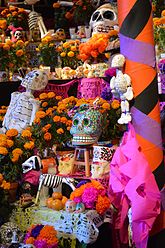
Plans for the solar day are fabricated throughout the year, including gathering the appurtenances to be offered to the expressionless. During the three-solar day menstruum families usually clean and decorate graves;[19] most visit the cemeteries where their loved ones are cached and decorate their graves with ofrendas (altars), which often include orange Mexican marigolds (Tagetes erecta) called cempasúchil (originally named cempōhualxōchitl , Nāhuatl for 'twenty flowers'). In modern Mexico the marigold is sometimes chosen Flor de Muerto ('Bloom of Expressionless'). These flowers are thought to attract souls of the dead to the offerings. It is also believed the bright petals with a strong scent can guide the souls from cemeteries to their family unit homes.[xx] [21]
Toys are brought for dead children ( los angelitos , or 'the piffling angels'), and bottles of tequila, mezcal or pulque or jars of atole for adults. Families will also offer trinkets or the deceased's favorite candies on the grave. Some families have ofrendas in homes, usually with foods such every bit candied pumpkin, pan de muerto ('bread of dead'), and carbohydrate skulls; and beverages such as atole . The ofrendas are left out in the homes as a welcoming gesture for the deceased.[19] [21] Some people believe the spirits of the dead consume the "spiritual essence" of the ofrendas ' nutrient, and then though the celebrators eat the food after the festivities, they believe information technology lacks nutritional value. Pillows and blankets are left out so the deceased can rest after their long journeying. In some parts of Mexico, such as the towns of Mixquic, Pátzcuaro and Janitzio, people spend all night beside the graves of their relatives. In many places, people have picnics at the grave site, also.

Some families build altars or small shrines in their homes;[nineteen] these sometimes feature a Christian cross, statues or pictures of the Blest Virgin Mary, pictures of deceased relatives and other people, scores of candles, and an ofrenda . Traditionally, families spend some time around the chantry, praying and telling anecdotes about the deceased. In some locations, celebrants wear shells on their clothing, so when they dance, the racket will wake upwardly the dead; some will also dress up every bit the deceased.
Food
During Day of the Dead festivities, nutrient is both eaten past living people and given to the spirits of their departed ancestors equally ofrendas ('offerings').[22] Tamales are one of the well-nigh common dishes prepared for this day for both purposes.[23]
Pan de muerto and calaveras are associated specifically with Solar day of the Dead. Pan de muerto is a type of sweet roll shaped like a bun, topped with sugar, and often decorated with bone-shaped pieces of the same pastry.[24] Calaveras , or sugar skulls, display colorful designs to stand for the vitality and individual personality of the departed.[23]
In add-on to nutrient, drinks are likewise important to the tradition of 24-hour interval of the Expressionless. Historically, the main alcoholic drink was pulque while today families volition commonly beverage the favorite drinkable of their deceased ancestors.[23] Other drinks associated with the vacation are atole and champurrado , warm, thick, non-alcoholic masa drinks.
Agua de Jamaica (water of hibiscus) is a popular herbal tea made of the flowers and leaves of the Jamaican hibiscus establish (Hibiscus sabdariffa), known as flor de Jamaica in Mexico. It is served cold and quite sweet with a lot of ice. The ruby-red beverage is likewise known equally hibiscus tea in English-speaking countries.[25]
In the Yucatán Peninsula, mukbil pollo (píib craven) is traditionally prepared on October 31 or Nov ane, and eaten past the family throughout the following days. It is like to a big tamale, composed of masa and pork lard, and blimp with pork, craven, tomato, garlic, peppers, onions, epazote, achiote, and spices. One time stuffed, the mukbil pollo is bathed in kool sauce, fabricated with meat goop, habanero chili, and corn masa. It is and so covered in banana leaves and steamed in an hugger-mugger oven over the course of several hours. One time cooked, it is dug up and opened to eat.[26] [27]
Calaveras
A common symbol of the holiday is the skull (in Spanish calavera ), which celebrants stand for in masks, called calacas (colloquial term for skeleton), and foods such as chocolate or sugar skulls, which are inscribed with the name of the recipient on the brow. Sugar skulls tin exist given equally gifts to both the living and the dead.[28] Other holiday foods include pan de muerto , a sweet egg staff of life made in diverse shapes from plain rounds to skulls, often decorated with white frosting to look like twisted basic.[21]
Calaverita
In some parts of the country, especially the larger cities, children in costumes roam the streets, knocking on people's doors for a calaverita , a small gift of candies or money; they also ask passersby for it. This custom is similar to that of Halloween's trick-or-treating in the United States, but without the component of mischief to homeowners if no care for is given.[29]
Calaveras literarias
A distinctive literary form exists within this holiday where people write short poems in traditional rhyming verse, called calaveras literarias (lit. "literary skulls"), which are mocking, light-hearted epitaphs mostly defended to friends, classmates, co-workers, or family unit members (living or expressionless) simply also to public or historical figures, describing interesting habits and attitudes, as well as comedic or absurd anecdotes that use death-related imagery which includes just is non express to cemeteries, skulls, or the grim reaper, all of this in situations where the dedicatee has an meet with death itself.[30] This custom originated in the 18th or 19th century later on a paper published a verse form narrating a dream of a cemetery in the future which included the words "and all of u.s.a. were dead", and and so proceeding to read the tombstones. Current newspapers dedicate calaveras literarias to public figures, with cartoons of skeletons in the fashion of the famous calaveras of José Guadalupe Posada, a Mexican illustrator.[28] In modern United mexican states, calaveras literarias are a staple of the holiday in many institutions and organizations, for example, in public schools, students are encouraged or required to write them as office of the linguistic communication class.[10]
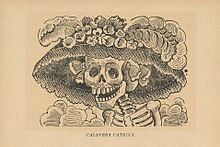
Posada created what might exist his most famous print, he called the print La Calavera Catrina ("The Elegant Skull") as a parody of a Mexican upper-form female. Posada'due south intent with the image was to ridicule the others that would claim the culture of the Europeans over the civilization of the indigenous people. The image was a skeleton with a big floppy hat decorated with two big feathers and multiple flowers on the meridian of the hat. Posada'southward hit paradigm of a costumed female with a skeleton face has become associated with the 24-hour interval of the Dead, and Catrina figures often are a prominent office of modern 24-hour interval of the Dead observances.[28]
Theatrical presentations of Don Juan Tenorio by José Zorrilla (1817–1893) are also traditional on this day.
Local traditions
The traditions and activities that accept place in celebration of the Day of the Dead are not universal, often varying from town to town. For example, in the boondocks of Pátzcuaro on the Lago de Pátzcuaro in Michoacán, the tradition is very different if the deceased is a child rather than an adult. On November one of the year after a child's death, the godparents set a table in the parents' dwelling with sweets, fruits, pan de muerto , a cantankerous, a rosary (used to ask the Virgin Mary to pray for them), and candles. This is meant to celebrate the child'south life, in respect and appreciation for the parents. There is also dancing with colorful costumes, often with skull-shaped masks and devil masks in the plaza or garden of the boondocks. At midnight on November 2, the people light candles and ride winged boats chosen mariposas (butterflies) to Janitzio, an isle in the centre of the lake where in that location is a cemetery, to award and celebrate the lives of the dead at that place.
In contrast, the town of Ocotepec, north of Cuernavaca in the Land of Morelos, opens its doors to visitors in commutation for veladoras (small-scale wax candles) to show respect for the recently deceased. In return the visitors receive tamales and atole . This is done merely past the owners of the house where someone in the household has died in the previous year. Many people of the surrounding areas make it early to swallow for gratuitous and enjoy the elaborate altars set up to receive the visitors.
Another peculiar tradition involving children is La Danza de los Viejitos (the Dance of the Old Men) where boys and young men dressed like grandfathers crouch and jump in an energetic dance.[31]
In the 2015 James Bond film Spectre, the opening sequence features a Twenty-four hours of the Expressionless parade in Mexico City. At the time, no such parade took place in United mexican states City; one year afterward, due to the involvement in the pic and the authorities desire to promote the Mexican culture, the federal and local regime decided to organize an bodily Día de Muertos parade through Paseo de la Reforma and Centro Historico on October 29, 2016, which was attended by 250,000 people.[32] [33] [34] This could be seen equally an example of the pizza event. The idea of a massive commemoration was as well popularized in the Disney Pixar pic Coco.
Observances outside of United mexican states
America
United states of america
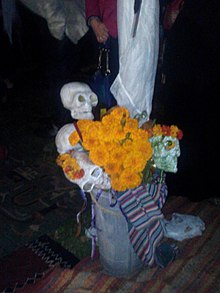

Women with calaveras makeup celebrating Día de Muertos in the Mission District of San Francisco, California
In many U.S. communities with Mexican residents, 24-hour interval of the Dead celebrations are very similar to those held in Mexico. In some of these communities, in states such equally Texas,[35] New Mexico,[36] and Arizona,[37] the celebrations tend to exist more often than not traditional. The All Souls Procession has been an annual Tucson, Arizona, effect since 1990. The event combines elements of traditional Twenty-four hour period of the Dead celebrations with those of heathen harvest festivals. People wearing masks carry signs honoring the dead and an urn in which people tin can place slips of paper with prayers on them to be burned.[38] Likewise, Sometime Town San Diego, California, annually hosts a traditional two-day celebration culminating in a candlelight procession to the historic El Campo Santo Cemetery.[39]
The festival too is held annually at celebrated Forest Hills Cemetery in Boston'south Jamaica Obviously neighborhood. Sponsored by Forest Hills Educational Trust and the folkloric performance group La Piñata, the Twenty-four hours of the Expressionless festivities celebrate the cycle of life and death. People bring offerings of flowers, photos, mementos, and nutrient for their departed loved ones, which they identify at an elaborately and colorfully decorated altar. A program of traditional music and dance also accompanies the customs event.
The Smithsonian Institution, in collaboration with the University of Texas at El Paso and Second Life, have created a Smithsonian Latino Virtual Museum and accompanying multimedia e-book: Día de los Muertos: Day of the Dead. The projection's website contains some of the text and images which explicate the origins of some of the customary core practices related to the Day of the Dead, such as the groundwork beliefs and the offrenda (the special altar commemorating 1'due south deceased loved one).[40] The Made For iTunes multimedia eastward-book version provides additional content, such as further details; additional photo galleries; popular-up profiles of influential Latino artists and cultural figures over the decades; and video clips[41] of interviews with artists who make Día de Muertos-themed artwork, explanations and performances of Aztec and other traditional dances, an animation brusk that explains the customs to children, virtual verse readings in English and Spanish.[42] [43]
In 2021, the Biden-Harris assistants celebrated the Día de Muertos.[44]
California
Santa Ana, California, is said to hold the "largest issue in Southern California" honoring Día de Muertos, chosen the annual Noche de Altares , which began in 2002.[45] The celebration of the Day of the Expressionless in Santa Ana has grown to two large events with the creation of an event held at the Santa Ana Regional Transportation Heart for the first time on November ane, 2015.[46]
In other communities, interactions between Mexican traditions and American culture are resulting in celebrations in which Mexican traditions are being extended to make artistic or sometimes political statements. For example, in Los Angeles, California, the Cocky Aid Graphics & Art Mexican-American cultural heart presents an annual Day of the Dead celebration that includes both traditional and political elements, such as altars to honor the victims of the Republic of iraq State of war, highlighting the high casualty rate among Latino soldiers. An updated, intercultural version of the Day of the Dead is also evolving at Hollywood Forever Cemetery.[47] There, in a mixture of Native Californian art, Mexican traditions and Hollywood hip, conventional altars are set up up adjacent with altars to Jayne Mansfield and Johnny Ramone. Colorful native dancers and music intermix with performance artists, while sly pranksters play on traditional themes.
Like traditional and intercultural updating of Mexican celebrations are held in San Francisco. For example, the Galería de la Raza, SomArts Cultural Heart, Mission Cultural Center, de Young Museum and altars at Garfield Foursquare by the Marigold Projection.[48] Oakland is abode to Corazon Del Pueblo in the Fruitvale district. Corazon Del Pueblo has a store offer handcrafted Mexican gifts and a museum devoted to Twenty-four hours of the Dead artifacts. Also, the Fruitvale district in Oakland serves as the hub of the Día de Muertos almanac festival which occurs the terminal weekend of October. Here, a mix of several Mexican traditions come together with traditional Aztec dancers, regional Mexican music, and other Mexican artisans to gloat the mean solar day.[49]
Asia and Oceania
Mexican-way Solar day of the Dead celebrations occur in major cities in Commonwealth of australia, Fiji, and Indonesia. Additionally, prominent celebrations are held in Wellington, New Zealand, consummate with altars celebrating the deceased with flowers and gifts.[50] In the Philippines "Undás", "Araw ng mga Yumao" (Tagalog: "Mean solar day of those who have died"), coincides with the Roman Catholic's celebration of All Saints' Twenty-four hours and continues on to the following day: All Souls' Solar day. Filipinos traditionally observe this day by visiting the family dead to clean and repair their tombs. Offerings of prayers, flowers, candles,[51] and fifty-fifty nutrient, while Chinese Filipinos additionally burn down joss sticks and joss paper (kim). Many as well spend the twenty-four hour period and ensuing nighttime holding reunions at the cemetery, having feasts and merriment.
Europe
As part of a promotion past the Mexican embassy in Prague, Czech Republic, since the belatedly 20th century, some local citizens join in a Mexican-style Twenty-four hour period of the Dead. A theater grouping conducts events involving candles, masks, and make-upwardly using luminous paint in the form of sugar skulls.[52] [53]
Americas
Belize
In Belize, Solar day of the Expressionless is practiced by people of the Yucatec Maya ethnicity. The celebration is known as Hanal Pixan which means 'food for the souls' in their language. Altars are constructed and busy with food, drinks, candies, and candles put on them.
Bolivia
Día de las Ñatitas ("Day of the Skulls") is a festival celebrated in La Paz, Bolivia, on May 5. In pre-Columbian times ethnic Andeans had a tradition of sharing a 24-hour interval with the basic of their ancestors on the third year after burying. Today families continue only the skulls for such rituals. Traditionally, the skulls of family members are kept at dwelling house to watch over the family and protect them during the yr. On November 9, the family crowns the skulls with fresh flowers, sometimes also dressing them in various garments, and making offerings of cigarettes, coca leaves, booze, and diverse other items in thanks for the year'southward protection. The skulls are likewise sometimes taken to the central cemetery in La Paz for a special Mass and approving.[54] [55] [56]
Brazil
The Brazilian public holiday of Dia de Finados, Dia dos Mortos or Dia dos Fiéis Defuntos (Portuguese: "Day of the Dead" or "Solar day of the Faithful Deceased") is celebrated on November ii. Similar to other Mean solar day of the Dead celebrations, people go to cemeteries and churches with flowers and candles and offering prayers. The celebration is intended equally a positive honoring of the dead. Memorializing the dead draws from indigenous and European Catholic origins.
Costa rica
Costa Rica celebrates Día De Los Muertos on Nov 2. The twenty-four hour period is likewise called Día de Todos Santos (All Saints Mean solar day) and Día de Todos Almas (All Souls Day). Catholic masses are celebrated and people visit their loved ones' graves to decorate them with flowers and candles.[57]
Ecuador
In Ecuador the Day of the Expressionless is observed to some extent by all parts of society, though it is peculiarly of import to the indigenous Kichwa peoples, who make upwards an estimated quarter of the population. Indigena families gather together in the community cemetery with offerings of food for a day-long remembrance of their ancestors and lost loved ones. Formalism foods include colada morada, a spiced fruit porridge that derives its deep purple color from the Andean blackberry and royal maize. This is typically consumed with wawa de pan, a bread shaped like a swaddled infant, though variations include many pigs—the latter existence traditional to the city of Loja. The bread, which is wheat flour-based today, merely was fabricated with masa in the pre-Columbian era, can be made savory with cheese inside or sweet with a filling of guava paste. These traditions take permeated mainstream society, as well, where food establishments add both colada morada and gaugua de pan to their menus for the season. Many non-indigenous Ecuadorians visit the graves of the deceased, cleaning and bringing flowers, or preparing the traditional foods, also.[58]
Guatemala
Guatemalan celebrations of the Day of the Dead, on November 1, are highlighted by the construction and flight of giant kites.[59] Information technology is customary to fly kites to assist the spirits detect their way back to World. A few kites have notes for the expressionless fastened to the strings of the kites. The kites are used equally a kind of telecommunications to sky.[28] A large event also is the consumption of fiambre, which is made merely for this day during the yr.[28] In add-on to the traditional visits to grave sites of ancestors, the tombs and graves are decorated with flowers, candles, and food for the dead. In a few towns, Guatemalans repair and repaint the cemetery with vibrant colors to bring the cemetery to life. They fix things that have gotten damaged over the years or just simply need a touch-up, such as wooden grave cantankerous markers. They too lay bloom wreaths on the graves. Some families have picnics in the cemetery.[28]
Peru
Information technology is common for Peruvians to visit the cemetery, play music and bring flowers to decorate the graves of expressionless relatives.[60]
Europe
Southern Italian republic and Sicily
A traditional biscotti-type cookie, ossa di morto or bones of the dead are fabricated and placed in shoes once worn past dead relatives.[61]
Run into also
- Danse Macabre
- Literary Calaverita
- Samhain
- Santa Muerte
- Skull art
- Th of the Dead
- Veneration of the expressionless
- Walpurgis Dark
- Qingming Festival
References
- ^ a b c d Foxcroft, Nigel H. (Oct 28, 2019). The Kaleidoscopic Vision of Malcolm Lowry: Souls and Shamans. Rowman & Littlefield. p. 130. ISBN978-ane-4985-1658-7.
Notwithstanding, owing to the subjugation of the Aztec Empire by the Castilian conquistador, Hernan Coretes in 1519–1521, this festival increasingly fell under Hispanic influence. It was moved from the beginning of summer to late October—and and then to early Nov—so that information technology would conicide with the Western Christian triduum (or three-day religious observance) of Allhallowtide (Hallowtide, Allsaintide, or Hallowmas). It lasts from October 31 to November two and comprises All Saint'due south Eve (Halloween), All Saints' Day (All Hallows'), and All Souls' Day.
- ^ "Día de Todos los Santos, Día de los Fieles Difuntos y Día de (los) Muertos (México) se escriben con mayúscula inicial" [Día de Todos los Santos, Día de los Fieles Difuntos and Día de (los) Muertos (Mexico) are written with initial uppercase letter] (in Spanish). Fundéu. October 29, 2010. Retrieved November iv, 2020.
- ^ "¿'Día de Muertos' o 'Día de los Muertos'? El nombre usado en México para denominar a la fiesta tradicional en la que se honra a los muertos es 'Día de Muertos', aunque la denominación 'Día de los Muertos' también es gramaticalmente correcta" ['Día de Muertos' or 'Día de los Muertos'? The proper noun used in Mexico to denominate the traditional celebration in which expiry is honored is 'Día de Muertos', although the denomination 'Día de los Muertos' is as well grammatically correct] (in Spanish). Regal Spanish Academy Official Twitter Account. November 2, 2019. Retrieved November 4, 2020.
- ^ Sacred Places of a Lifetime. National Geographic. 2008. p. 273. ISBN978-1-4262-0336-seven.
Day of the Dead celebrations take place over October 31 ... Nov 1 (All Saints' Twenty-four hours), and November 2.
- ^ Skibo, James; Skibo, James Yard.; Feinman, Gary (January 14, 1999). Pottery and People. University of Utah Press. p. 65. ISBN978-0-87480-577-2.
In Yucatan, yet, the Twenty-four hours of the Dead rituals occur on October 31, November ane, and Nov 6.
- ^ Arnold, Dean East. (Feb seven, 2018). Maya Potters' Ethnic Noesis: Knowledge, Appointment, and Exercise. University Press of Colorado. p. 206. ISBN978-1-60732-656-four.
pottery as a distilled taskscape is best illustrated in the pottery required for 24-hour interval of the Dead rituals (on Oct 31, November ane, and Nov 6), when the spirits of deceased ancestors come back to the land of the living.
- ^ Gild, National Geographic (October 17, 2012). "Dia de los Muertos". National Geographic Society . Retrieved April 8, 2019.
- ^ a b Palfrey, Dale Hoyt (1995). "The Day of the Expressionless". Día de los Muertos Index. Access Mexico Connect. Archived from the original on Nov 30, 2007. Retrieved Nov 28, 2007.
- ^ "Dia de los Muertos". National Geographic Society. October 17, 2012. Archived from the original on November 2, 2016. Retrieved November ii, 2016.
- ^ a b Chávez, Xóchitl (Oct 23, 2018). "Literary Calaveras". Smithsonian Voices.
- ^ a b "Ethnic festivity dedicated to the expressionless". UNESCO. Archived from the original on October 11, 2014. Retrieved Oct 31, 2014.
- ^ a b c d east "Día de muertos, ¿tradición prehispánica o invención del siglo Twenty?". Relatos eastward Historias en México. November 2, 2020.
- ^ a b "Dos historiadoras encuentran diverso origen del Día de Muertos en México". www.opinion.com.bo.
- ^ a b ""Día de Muertos, un invento cardenista", decía Elsa Malvido". El Universal. November 3, 2017.
- ^ a b "El Día de Muertos mexicano nació como arma política o tradición prehispánica - Arte y Cultura - IntraMed". world wide web.intramed.net.
- ^ a b c "Orígenes profundamente católicos y no prehispánicos, la fiesta de día de muertos". world wide web.inah.gob.mx.
- ^ "09an1esp". www.jornada.com.mx.
- ^ Paz,Octavio. 'The Labyrinth of Solitude'. N.Y.: Grove Printing, 1961.
- ^ a b c Salvador, R.J. (2003). John D. Morgan and Pittu Laungani (ed.). Expiry and Bereavement Around the World: Death and Bereavement in the Americas. Death, Value and Meaning Series, Vol. II. Amityville, New York: Baywood Publishing Company. pp. 75–76. ISBN978-0-89503-232-4.
- ^ "five Facts About Día de los Muertos (The Solar day of the Dead)". Smithsonian Insider. October 30, 2016. Archived from the original on August 29, 2018. Retrieved August 29, 2018.
- ^ a b c Brandes, Stanley (1997). "Sugar, Colonialism, and Death: On the Origins of Mexico's Solar day of the Expressionless". Comparative Studies in Society and History. 39 (2): 275. doi:x.1017/S0010417500020624. ISSN 0010-4175. JSTOR 179316. S2CID 145402658.
- ^ Turim, Gayle (November 2, 2012). "Mean solar day of the Expressionless Sweets and Treats". History Stories. History Channel. Archived from the original on June 6, 2015. Retrieved July 1, 2015.
- ^ a b c Godoy, Maria (November 2016). "Sugar Skulls, Tamales And More: Why Is That Food On The Twenty-four hour period Of The Dead Altar?". NPR. Archived from the original on Oct 28, 2017. Retrieved October 25, 2017.
- ^ Castella, Krystina (October 2010). "Pan de Muerto Recipe". Epicurious. Archived from the original on July 8, 2015. Retrieved November 2, 2019.
- ^ "Jamaica iced tea". Cooking in United mexican states. Archived from the original on November iv, 2011. Retrieved Oct 23, 2011.
- ^ Kennedy, D. (2018). Cocina esencial de México. Fondo de Cultura Económica. p. 156. ISBN9786071656636 . Retrieved June ane, 2021.
- ^ R., Muñoz. "Muc bil pollo". Diccionario enciclopédico de la Gastronomía Mexicana [Enciclopedic dictionary of Mexican Gastronomy] (in Castilian). Larousse Cocina.
- ^ a b c d eastward f Marchi, Regina 1000 (2009). Day of the Dead in the USA : The Migration and Transformation of a Cultural Phenomenon. New Brunswick: Rutgers University Press. p. 17. ISBN978-0-8135-4557-eight.
- ^ "Mi Calaverita: Mexico's Play a trick on or Treat". Mexperience. October 31, 2020.
- ^ "These wicked Day of the Expressionless poems don't spare anyone". PBS NewsHour. November 2, 2018. Retrieved May half dozen, 2019.
- ^ "Día de los Muertos or Twenty-four hours of the Dead". Archived from the original on August 29, 2018. Retrieved August 29, 2018.
- ^ "United mexican states City stages first Twenty-four hours of the Dead parade". BBC. October 29, 2016. Archived from the original on Oct 30, 2016. Retrieved November 1, 2016.
- ^ "Fotogalería: Desfile por Día de Muertos reúne a 250 mil personas". Excélsior (in Spanish). October 29, 2016. Archived from the original on October 31, 2016. Retrieved Nov 1, 2016.
- ^ "Galerías Archivo". Televisa News. Archived from the original on November 3, 2016. Retrieved November 1, 2016.
- ^ Wise, Danno. "Port Isabel's Day of the Expressionless Commemoration". Texas Travel. About.com. Archived from the original on December ix, 2007. Retrieved November 28, 2007.
- ^ "Dia de los Muertos". visitalbuquerque.org. Archived from the original on Nov 3, 2016. Retrieved November ane, 2016.
- ^ Hedding, Judy. "Day of the Dead". Phoenix. Most.com. Archived from the original on December eleven, 2007. Retrieved Nov 28, 2007.
- ^ White, Erin (November 5, 2006). "All Souls Procession". Arizona Daily Star. Archived from the original on November 6, 2012. Retrieved November 28, 2007.
- ^ "Quondam Town San Diego's Dia de los Muertos". Archived from the original on November 7, 2014. Retrieved October nineteen, 2014.
- ^ Smithsonian Latino Virtual Museum. Día de los Muertos: Day of the Expressionless (Version one.ii ed.). Archived from the original on Dec 22, 2014. Retrieved October 31, 2014.
- ^ "Smithsonian Latino Virtual Museum". Ustream. Archived from the original on October 31, 2014. Retrieved Oct 31, 2014.
- ^ Smithsonian Latino Virtual Museum. "Day of the Expressionless". Theater of the Dead. Archived from the original on November 12, 2014. Retrieved October 31, 2014.
- ^ Smithsonian Establishment. "Smithsonian-UTEP Día de los Muertos Festival: A 2nd and 3D Feel!". Smithsonian Latino Virtual Museum Press Release. Archived from the original on November six, 2009.
- ^ @LaCasaBlanca (November 1, 2021). "Feliz Día de los Muertos de la Administración Biden-Harris. Hoy y mañana, el Presidente y la Primera Dama reconocerán el Día de los Muertos con la primera ofrenda ubicada en la Casa Blanca" (Tweet) (in Spanish). Retrieved November iv, 2021 – via Twitter.
- ^ "Less-scary holiday: Some organized religion groups offering alternatives to Halloween trick-or-treating". The Orange County Register. October 30, 2015. Archived from the original on Oct 31, 2015. Retrieved Nov 2, 2015.
- ^ "Viva la Vida or Noche de Altares? Santa Ana's downtown division fuels dueling Day of the Expressionless events". The Orange County Register. October 30, 2015. Archived from the original on November 3, 2015. Retrieved November 2, 2015.
- ^ Quinones, Sam (October 28, 2006). "Making a nighttime of Day of the Dead". Los Angeles Times . Retrieved November 26, 2006.
- ^ "Dia de los Muertos [Day of the Expressionless] – San Francisco". Archived from the original on October 17, 2014. Retrieved October nineteen, 2014.
- ^ Elliott, Vicky (October 27, 2000). "Lively Petaluma festival marks 24-hour interval of the Dead". The San Francisco Chronicle. Archived from the original on July 8, 2012. Retrieved August 6, 2010.
- ^ "Day of the Dead in Wellington, New Zealand". Scoop.co.nz. October 27, 2007. Archived from the original on June 4, 2009. Retrieved August 13, 2009.
- ^ "All Saints Day around the world". Guardian Weekly. Nov 1, 2010. Archived from the original on October 29, 2018. Retrieved Oct 30, 2018.
- ^ "48 All-time Carbohydrate Skull Makeup Creations To Mean solar day of the Expressionless". Baronial 22, 2017. Retrieved Oct 14, 2019.
- ^ "Day of the Dead in Prague". Radio Czech. October 24, 2007. Archived from the original on Oct 24, 2007.
- ^ Guidi, Ruxandra (Nov nine, 2007). "Las Natitas". BBC. Archived from the original on December 6, 2008.
- ^ Smith, Fiona (Nov 8, 2005). "Bolivians Award Skull-Toting Tradition". Associated Press. Archived from the original on February 18, 2008. Retrieved December 30, 2007.
- ^ "All Saints day in Bolivia – "The skull festival"". Bolivia Line (May 2005). Archived from the original on October 23, 2008. Retrieved December xx, 2007.
- ^ Costa rica Celebrates The Day of the Dead Outward Bound Costa Rica, 2012-11-01.
- ^ Ortiz, Gonzalo (October 30, 2010). "Diversity in Remembering the Dead". InterPress Service News Agency. Archived from the original on November four, 2010. Retrieved October 30, 2010.
- ^ Burlingame, Betsy; Wood, Joshua. "Visit to cemetery in Guatemala". Expatexchange.com. Archived from the original on Oct 14, 2007. Retrieved August 13, 2009.
- ^ "Perú: así se vivió Día de todos los santos en cementerios de Lima". Republic of peru. peru.com. January 1, 2016. Archived from the original on November vii, 2017. Retrieved October 30, 2017.
- ^ "Bones of the Expressionless Cookies - Ossa Di Morto". Savoring Italian republic. October 24, 2019. Retrieved November 2, 2021.
Further reading
- Andrade, Mary J. Twenty-four hour period of the Dead A Passion for Life – Día de los Muertos Pasión por la Vida. La Oferta Publishing, 2007. ISBN 978-0-9791624-04
- Anguiano, Mariana, et al. Las tradiciones de Día de Muertos en México. United mexican states City 1987.
- Brandes, Stanley (1997). "Sugar, Colonialism, and Death: On the Origins of Mexico's Twenty-four hour period of the Expressionless". Comparative Studies in Society and History. 39 (two): 270–99. doi:10.1017/S0010417500020624. S2CID 145402658.
- Brandes, Stanley (1998). "The Day of the Expressionless, Halloween, and the Quest for Mexican National Identity". Journal of American Sociology. 111 (442): 359–80. doi:10.2307/541045. JSTOR 541045.
- Brandes, Stanley (1998). "Iconography in United mexican states'southward Day of the Dead". Ethnohistory. Duke Academy Printing. 45 (2): 181–218. doi:x.2307/483058. JSTOR 483058.
- Brandes, Stanley (2006). Skulls to the Living, Bread to the Dead. Blackwell Publishing. p. 232. ISBN978-one-4051-5247-1.
- Cadafalch, Antoni. The Day of the Expressionless. Korero Books, 2011. ISBN 978-1-907621-01-7
- Carmichael, Elizabeth; Sayer, Chloe. The Skeleton at the Feast: The Day of the Dead in Mexico. Great britain: The Bath Press, 1991. ISBN 0-7141-2503-2
- Conklin, Paul (2001). "Decease Takes a Vacation". U.Due south. Catholic. 66: 38–41.
- Garcia-Rivera, Alex (1997). "Death Takes a Holiday". U.S. Catholic. 62: 50.
- Haley, Shawn D.; Fukuda, Brusque. Day of the Dead: When 2 Worlds Meet in Oaxaca. Berhahn Books, 2004. ISBN ane-84545-083-3
- Lane, Sarah and Marilyn Turkovich, Días de los Muertos/Days of the Dead. Chicago 1987.
- Lomnitz, Claudio. Decease and the Thought of Mexico. Zone Books, 2005. ISBN 1-890951-53-6
- Matos Moctezuma, Eduardo, et al. "Miccahuitl: El culto a la muerte," Special event of Artes de México 145 (1971)
- Nutini, Hugo G. Todos Santos in Rural Tlaxcala: A Syncretic, Expressive, and Symbolic Assay of the Cult of the Dead. Princeton 1988.
- Oliver Vega, Beatriz, et al. The Days of the Expressionless, a Mexican Tradition. Mexico City 1988.
- Roy, Ann (1995). "A Crack Between the Worlds". Commonwealth. 122: 13–xvi.
Source: https://en.wikipedia.org/wiki/Day_of_the_Dead
0 Response to "Mexican Day of the Dead Charahcters Jarritos Clip Art"
Post a Comment